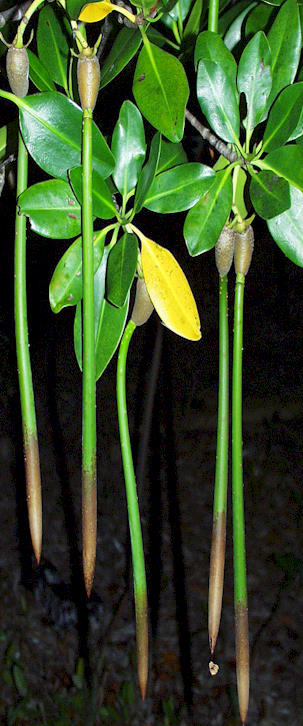
The red mangrove features expansive branches of aerial roots that are arched above the water line to provide the plant with oxygen before entering the water. These prop roots provide the plant with stability in sandy substrate and help to gather oxygen for underground parts of the plant. Many colorful invertebrates, as well as sponges and algae, colonize the roots in the coastal habitats where they grow. The red mangrove is by far the most important species, due to its ability to prevent erosion by actually building land structures and miniature islands over time. Mature trees can reach heights of up to 80 feet. In the aquarium it is very hardy and only requires minimal care once established. The pencil shaped seeds can be inserted and floated in small pieces of styrofoam, staked to the substrate with dowels or pvc pipe, or simply planted so that the leaves are above the water line. The leaves should be periodically sprayed with fresh water to remove salt deposits. All mangroves are slow growing in the aquarium and are not as efficient at removing nutrients as algae and sea grasses are. However, they have their place in the hobby as an interesting and functional part of a marine ecosystem. The red mangrove is readily available to the aquarist as both a seed and seedling from various marine life collectors and nurseries.
Scientific Name: Rhizophora mangle
Common Name: Red Mangrove
Origin: Gulf of Mexico, Atlantic, Caribbean
Depth Collected: low tide zone
Maximum Height : 80′
Growth Rate: Slow
Light: High
Temperature: 60-100
Propagation: Rhizomes, Seeds
Difficulty: Easy
Food Value: None
Nutrient Uptake: Fair once established
Flow Rate: Low