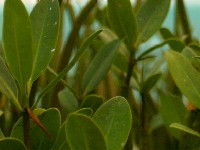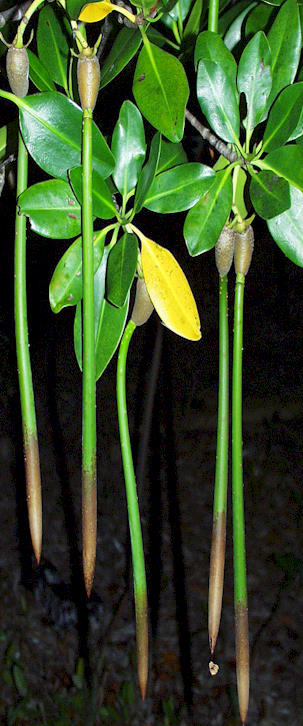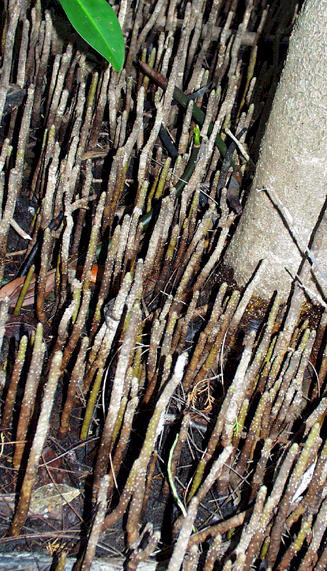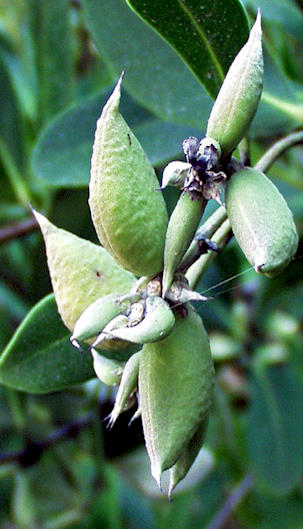
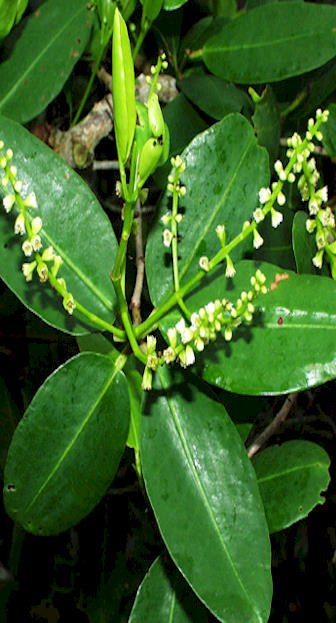
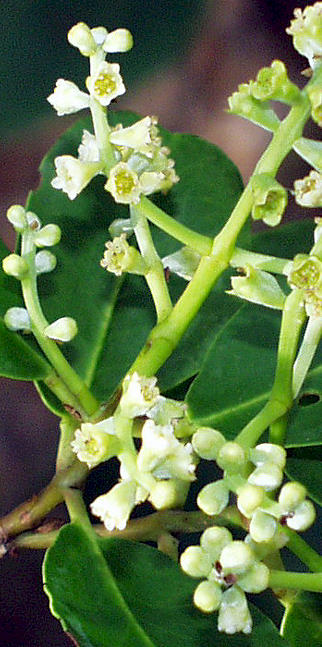
The white mangrove is usually found further inland of the red and black mangroves and is the most cold-sensitive of the mangroves. The white mangrove features a pair of nodular, salt-excreting glands found near the tip of each leaf stalk and a series of blackish glands between the middle vein. The seeds or fruit of the white mangrove are round and the flowers are white. One of the distinguishing characteristics are the rounded leaves that feature a notched tip. Unlike both red & black mangroves, white mangroves lack specialized aerial roots, though under certain conditions may produce a few “peg roots” similar to those of the black mangrove. Flowering is in spring and early summer. Because of the lack of breathing tubes or aerial roots, the white mangrove is difficult to grow in the marine aquarium. Some have had success with simply floating collected seed pods, but the plant normally dies as its roots can not be submersed long term. Its only suited for biotopes that allow for the root system to be partially above the water line.
Scientific Name: Laguncularia racemosa
Common Name: White Mangrove
Origin: Gulf of Mexico, Atlantic, Caribbean
Depth Collected: low tide zone
Maximum Height : 60′
Growth Rate: Slow
Light: High
Temperature: 65-100
Propagation: Rhizomes, Seeds
Difficulty: Advanced
Food Value: None
Nutrient Uptake: Fair once established
Flow Rate: Low