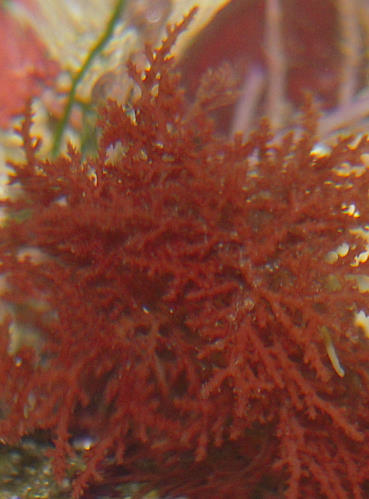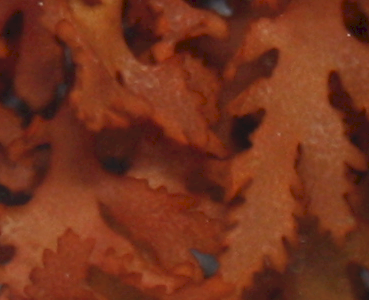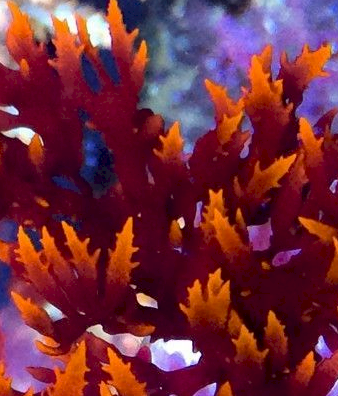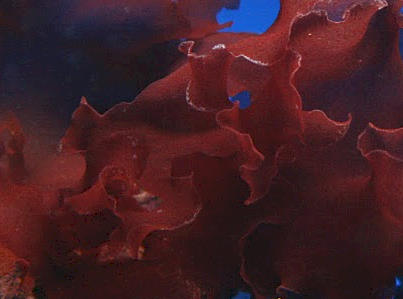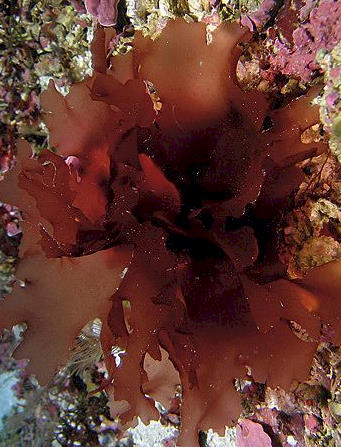
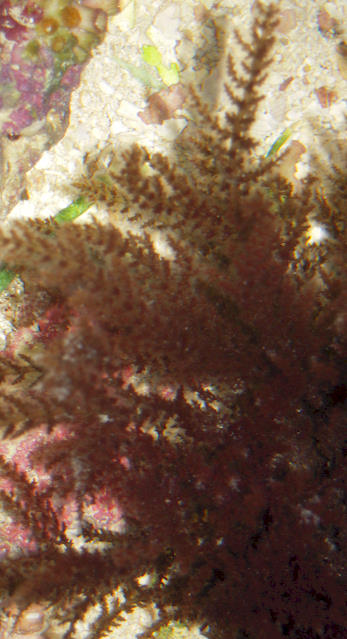
Ancanthopora spicifera

This interesting red macro algae is one of the only species that has a brown coloration. It features tall, irregular and stiff uprights composed of smaller, pointed branches. It is often confused with Laurencia as it has similar characteristics, but the branches of this species are much finer and more compact. This species has a single holdfast that attaches to rocks, shells and other hard bottom habitat, typically in shallow costal habitats with strong tidal surge. A fast grower, it can be invasive in reef aquariums so care must be taken to regularly prune each specimen. It’s collected in shallow water from the low tide zone to depths of about 10ft. If placed under strong lighting, it often has a brilliant white appearance.
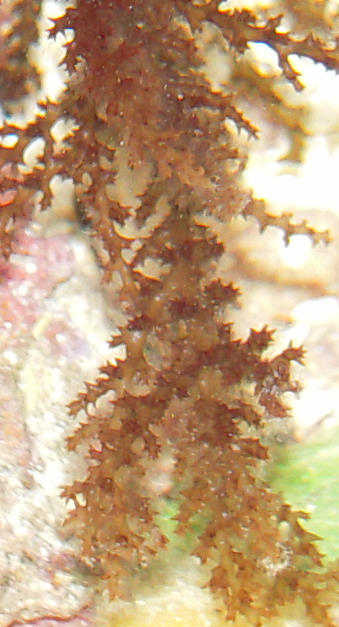
Scientific Name: Ancanthopora spicifera

Common Name: Fire Fern

Origin: Gulf of Mexico. Atlantic, Caribbean

Maximum Height : 8″

Growth Rate: Moderate

Light: Moderate to High

Temperature: 78-86

Propagation: Fragmentation, Sporulation

Difficulty: Easy

Food Value: Not very palatable

Nutrient Uptake: Good

Flow Rate: Moderate to High
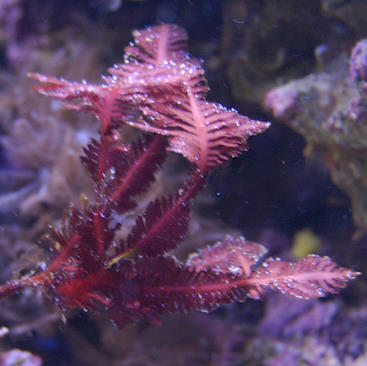
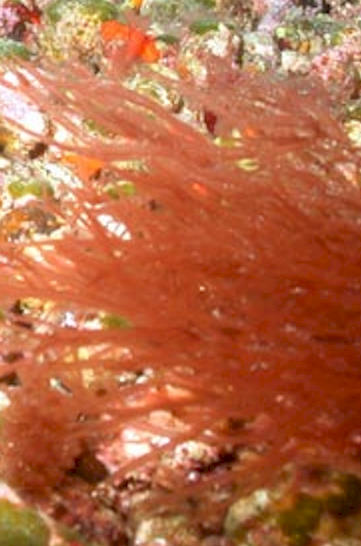
Haliptilon sp.

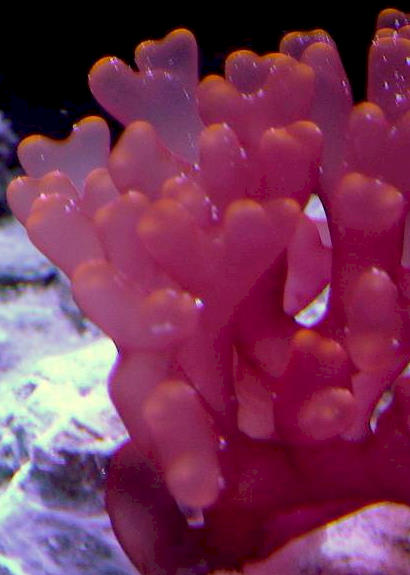
A very popular species of red algae for use in the aquarium. Species of Haliptilon feature calcified or heavily calcified branches with fern or feather shaped blades. Depending on the individual species, they are red or pinkish in coloration and typically grow in the reef flat and tidal zone on rocks and as epiphytic algae on other plants. Currently the red fern (left) is the only species of Haliptilon available in the aquarium hobby today. It’s typically found as a colony or multiple colonies attached to smaller pieces of imported live rock. Although most species of Haliptilon are considered temperate water algae, they can tolerate warmer temperatures and do very well in the marine aquarium.

Scientific Name: Haliptilon sp.

Common Name: Red Fern, Smooth Kelp

Origin: Indonesia, S. Pacific

Maximum Height : 8″

Growth Rate: Moderate

Light: Moderate to High

Temperature: 60-78

Propagation: Fragmentation, Sporulation

Difficulty: Easy

Food Value: Somewhat Palatable

Nutrient Uptake: Fair

Flow Rate: Moderate

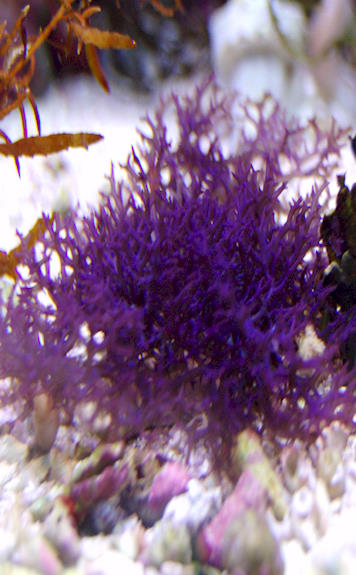
Hypnea pannosa

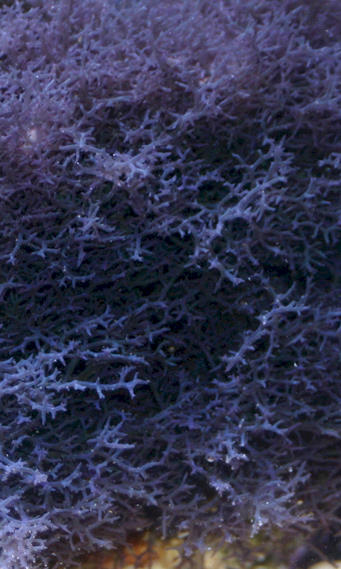
This particular algae is one of only a handful of blueish-iridescent specimens available in the aquarium hobby. It’s native to the Indo Pacific and was imported into the United States many years ago. It’s often confused with a similar species from the Caribbean called ochtodes but it’s not related. It features coarse, bushy, compact branches that grow as small clumps or mounds. It’s considered a turf algae and will quickly overgrow its environment given the proper conditions. They are found in shallow, turbulent areas, attached to rocks, hard bottom or epithetic on other plants. In the aquarium they need relatively bright light and low to moderate current, but are adaptable to a wide range of conditions. It tends to grow in cycles and will routinely start to die off if not divided occasionally. It’s is known to be palatable to some crabs, urchins and invertebrates, but is generally left alone in favor of a more suitable food source.

Scientific Name: Hypnea pannosa

Common Name: Blue Ball

Origin: Indo Pacific

Depth Collected: 5-45 feet

Maximum Height: 6″

Growth Rate: Moderate

Light: Moderate to High

Temperature: 78-84

Propagation: Fragmentation, Sporulation

Difficulty: Moderate

Food Value: Somewhat Palatable

Nutrient Uptake: Good

Flow Rate: Moderate

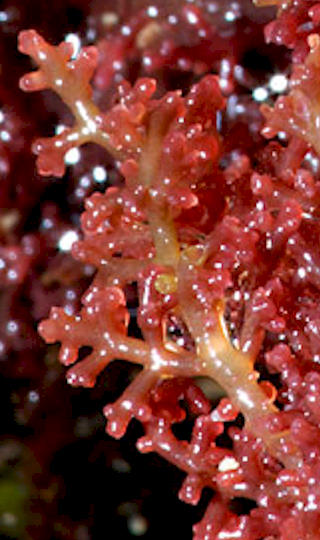
Nemastoma sp. 

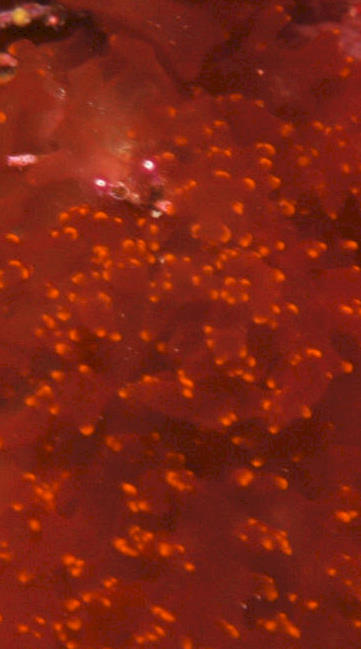
A beautiful red algae from the Pacific that features a deep red coloration with gelatinous, slippery branches attached by a single holdfast. Its branches are filled with fluid, much like Botryocladia, to keep it buoyant. This particular algae is highly variable depending on the individual species and often features bright orange or white tips. This species is rarely seen in the aquarium industry and is typically introduced through the importation of collected live rock or coral colonies. Once established, it’s very hardy and will grow well in a variety of aquarium conditions, even low light environments. Most species favor good water quality and moderate water current. It’s palatable to most fish and invertebrates.

Scientific Name: Nemastoma sp. 

Common Name: Mickey Mouse Ears

Origin: Caribbean, Indonesia, S. Pacific

Maximum Height : 6″

Growth Rate: Moderate

Light: Moderate to High

Temperature: 72-82

Propagation: Fragmentation, Sporulation

Difficulty: Moderate

Food Value: Palatable

Nutrient Uptake: Good

Flow Rate: Moderate to High
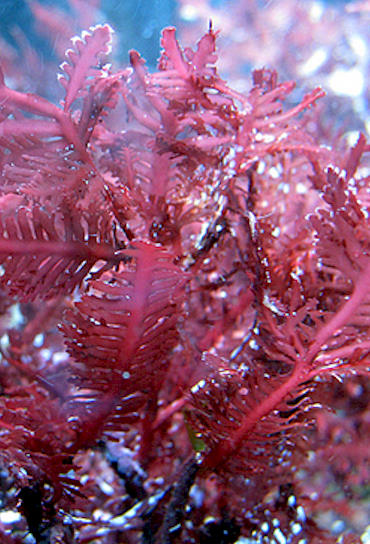
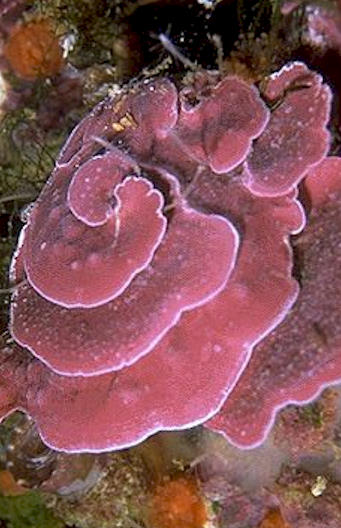
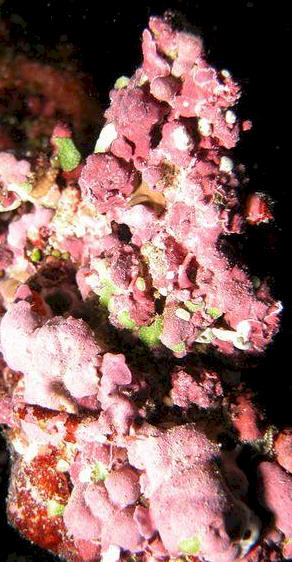
Lithophyllum sp.

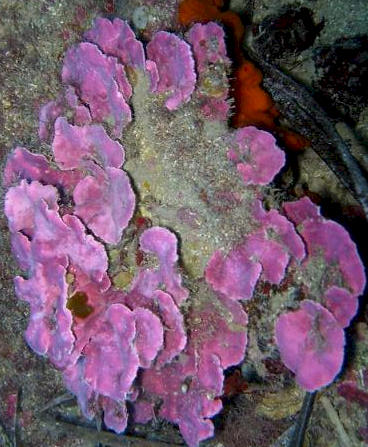
Lithophyllum is a calcareous encrusting algae that forms heavily calcified plates or discs that encrust rocks and coral reefs. Like many encrusting algae, it plays an important role in building reef structures by cementing dead coral tissue and fragments together. It features overlapping pink colored irregular shaped discs, often with a distinctive white edge. Existing fragments can be broken off and glued to live rock in the aquarium. This species is most often encountered on imported live rock as it’s native to the reef and can be difficult to obtain. Like most heavily encrusting macro algae species it requires large amounts of calcium supplementation to grow.

Scientific Name: Lithophyllum sp. 

Common Name: Coralline Algae

Origin: Caribbean, S. Pacific

Depth Collected: 1-50 feet

Maximum Height: 8″

Growth Rate: Slow

Light: Moderate to High

Temperature: 72-82

Propagation: Sporulation

Difficulty: Moderate

Food Value: Not Palatable

Nutrient Uptake: None

Flow Rate: Moderate to High

Laurencia sp.

Laurencia is a highly variable species with worldwide distribution. It features bright red, rather stiff branches that are connected to long cylindrical uprights. The branches are typically short with pointed tips. Because of the variation in color, branching pattern and texture within each species, it can sometimes be difficult to identify, especially in younger plants. Some species such as Laurencia iridescens, have a beautiful purple iridescent quality. Most species are native to the reef flat, as well as shallow inter-tidal habitats, growing on rocks, rubble and hard bottom. It frequently grows on other plants as an epithetic algae in sea grass beds and the reef flat. In the aquarium its a relatively undemanding specimen and will grow as long as sufficient light and nutrients are available. Most species of Laurencia are small and will only grow to about 6″ or so. Palatable to some fish and invertebrates.

Scientific Name: Laurencia sp.

Common Name: Unknown

Origin: Gulf of Mexico, Caribbean, South Pacific

Maximum Height : 8″

Growth Rate: Moderate

Light: Moderate

Temperature: 76-80

Propagation: Fragmentation, Sporulation

Difficulty: Moderate

Food Value: Somewhat Palatable

Nutrient Uptake: Good

Flow Rate: Moderate 

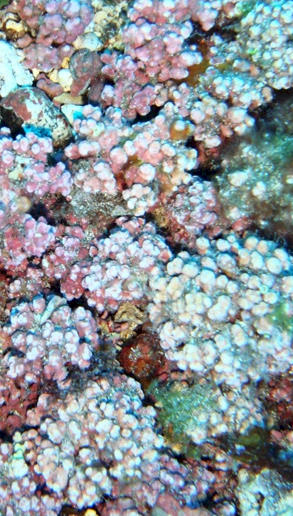
Hydrolithon sp.

The species Hydrolithon is a calcareous encrusting algae that forms an irregular, knobby shaped crust on shallow rocks and coral reefs. Like many encrusting algae, they play an important role in building reef structures by cementing dead coral tissue and fragments together. Individual species of Hydrolithon come in many different shades of a red, pink and deep purple. It’s abundant on both the reef and near shore habitats in the Caribbean and Gulf of Mexico. Some species grow in very shallow water among the edge of seagrass beds in the Caribbean where they form large colonies of individual specimens. It does well in aquariums with good amounts of calcium.

Scientific Name: Hydrolithon sp.

Common Name: Corraline Algae

Origin: Caribbean, S. Pacific, Gulf of Mexico

Depth Collected: 1-60 feet

Maximum Height: 6″

Growth Rate: Slow

Light: Moderate to High

Temperature: 72-82

Propagation: Sporulation

Difficulty: Moderate

Food Value: Not Palatable

Nutrient Uptake: None

Flow Rate: Moderate to High

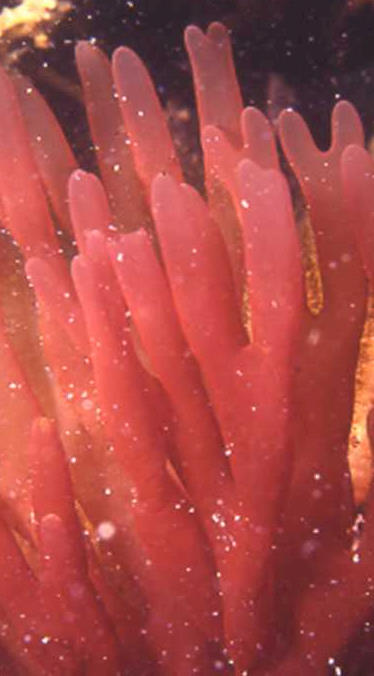
Halymenia elongata

Halymenia elongata features long, tubular branches, that are attached by a single holdfast to form tight symmetrical clumps. It’s both gelatinous and fleshy ranging in color from yellow to pinkish-red. The tips of each individual branch can be both rounded or split into multiple finger-like appendages. At first glance, it often resembles Gracilaria, as the appearance is very similar. It occurs in moderate to deep water habitats up to 100ft. In the aquarium, its needs are very similar to other varieties of Halymenia, but it can be more challenging to keep in the aquarium due to it’s large cell structure. This species is often encountered as drift algae, but grows attached to hard bottom, rocks and shells in high flow habitats. Individual specimens are rarely available for hobbyists, but are occasionally offered by some marine life collectors in Florida. Like most species of Halymenia it is palatable to fish and invertebrates.

Scientific Name: Halymenia elongata

Common Name: Red Finger Algae

Origin: Caribbean, Gulf of Mexico

Maximum Height : 12″

Growth Rate: Moderate

Light: Moderate to High

Temperature: 72-82

Propagation: Fragmentation, Sporulation

Difficulty: Moderate

Food Value: Palatable

Nutrient Uptake: Good

Flow Rate: Moderate to High
Halymenia durvillei

This popular species of Halymenia is native to the Indo-Pacific Ocean which was imported into the United States as an ornamental algae for the aquarium trade. It’s unclear when or how it was first introduced in the United States, but is widely cultivated today by numerous hobbyists and coral farmers. Unlike other species of Halymenia, the tissue on this particular macro algae isn’t as thin and is slightly rigid. It features a deep red coloration and a brilliant orange-yellow fluorescence at the tips of each individual frond. It’s a very hardy species once established but grows in cycles so should be divided regularly to preserve the algae. 

Scientific Name: Halymenia durvillei

Common Name: Dragon’s Breath

Origin: Indo Pacific

Maximum Height : 10″

Growth Rate: Moderate

Light: Moderate to High

Temperature: 76-82

Propagation: Fragmentation, Sporulation

Difficulty: Easy

Food Value: Somewhat Palatable

Nutrient Uptake: Good

Flow Rate: Moderate

Halymenia floridana

An interesting species of Halymenia that’s highly variable in color, ranging from bright yellow to red depending on the depth collected. Like all species of Halymenia, it’s gelatinous, slippery and smooth in texture and has no shape out of water. It’s thin fronds are very delicate and can break apart and tear when handled or subjected to high flow. This particular species stays rather compact and it’s blades are rounded and irregular similar to species of Ulva. Most Halymenia species grow in rather deep locations so do not require as much light as some other algae. Specimens are encountered either free floating or attached to rocks and protected ledges by a single holdfast. In the aquarium, it will seldom attach to anything on it’s own, so it must be anchored manually or allowed to tumble as a free floating specimen. H. floridana is very palatable and is readily eaten by both tangs, angels and herbivores.

Scientific Name: Halymenia floridana

Common Name: Red Sea Lettuce

Origin: Gulf of Mexico, Caribbean, Atlantic

Maximum Height : 18″

Growth Rate: Moderate

Light: Moderate to Low

Temperature: 76-82

Propagation: Fragmentation, Sporulation

Difficulty: Easy

Food Value: Very palatable

Nutrient Uptake: Good

Flow Rate: Moderate to High