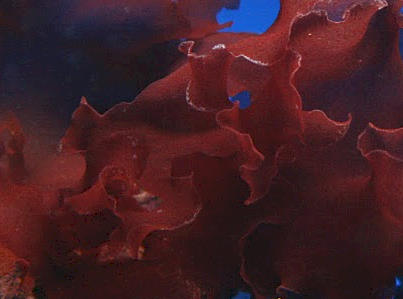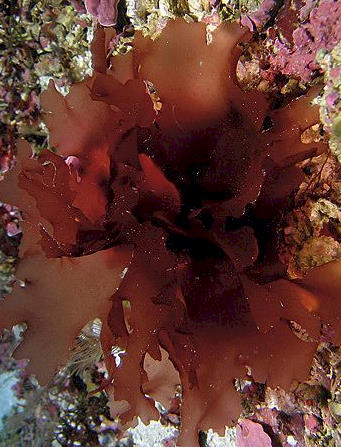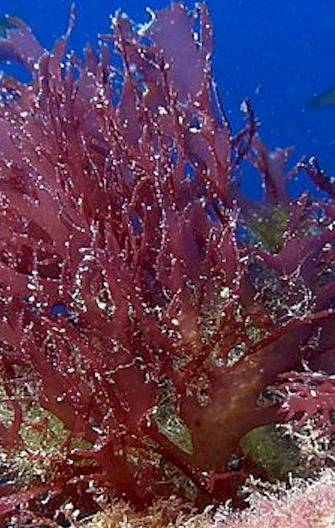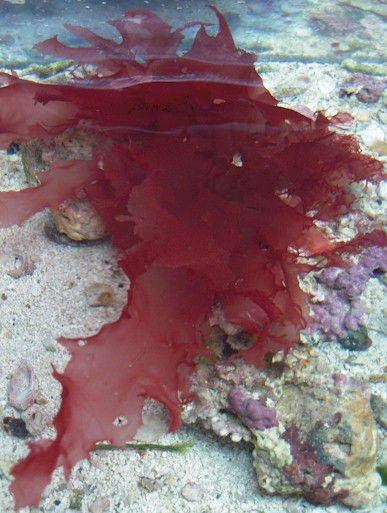
Halymenia elongata

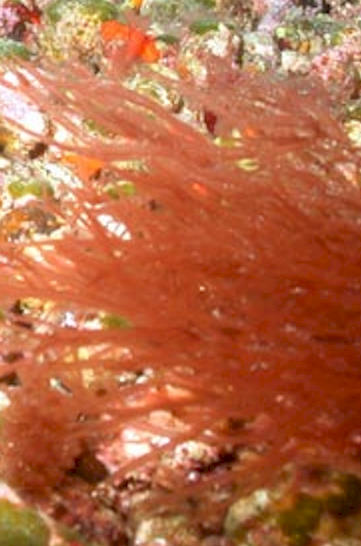
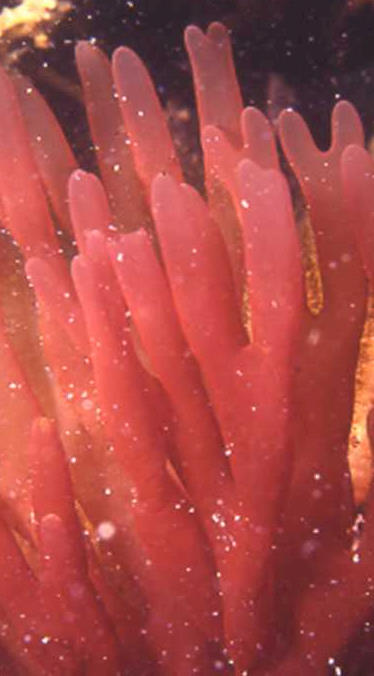
Halymenia elongata features long, tubular branches, that are attached by a single holdfast to form tight symmetrical clumps. It’s both gelatinous and fleshy ranging in color from yellow to pinkish-red. The tips of each individual branch can be both rounded or split into multiple finger-like appendages. At first glance, it often resembles Gracilaria, as the appearance is very similar. It occurs in moderate to deep water habitats up to 100ft. In the aquarium, its needs are very similar to other varieties of Halymenia, but it can be more challenging to keep in the aquarium due to it’s large cell structure. This species is often encountered as drift algae, but grows attached to hard bottom, rocks and shells in high flow habitats. Individual specimens are rarely available for hobbyists, but are occasionally offered by some marine life collectors in Florida. Like most species of Halymenia it is palatable to fish and invertebrates.
Scientific Name: Halymenia elongata

Common Name: Red Finger Algae

Origin: Caribbean, Gulf of Mexico

Maximum Height : 12″

Growth Rate: Moderate

Light: Moderate to High

Temperature: 72-82

Propagation: Fragmentation, Sporulation

Difficulty: Moderate

Food Value: Palatable

Nutrient Uptake: Good

Flow Rate: Moderate to High
Halymenia durvillei

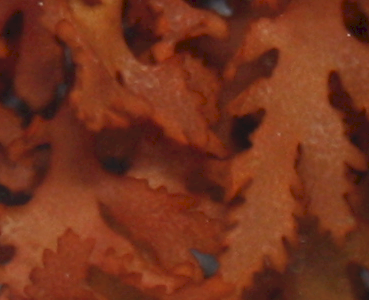
This popular species of Halymenia is native to the Indo-Pacific Ocean which was imported into the United States as an ornamental algae for the aquarium trade. It’s unclear when or how it was first introduced in the United States, but is widely cultivated today by numerous hobbyists and coral farmers. Unlike other species of Halymenia, the tissue on this particular macro algae isn’t as thin and is slightly rigid. It features a deep red coloration and a brilliant orange-yellow fluorescence at the tips of each individual frond. It’s a very hardy species once established but grows in cycles so should be divided regularly to preserve the algae. 

Scientific Name: Halymenia durvillei

Common Name: Dragon’s Breath

Origin: Indo Pacific

Maximum Height : 10″

Growth Rate: Moderate

Light: Moderate to High

Temperature: 76-82

Propagation: Fragmentation, Sporulation

Difficulty: Easy

Food Value: Somewhat Palatable

Nutrient Uptake: Good

Flow Rate: Moderate

Halymenia floridana

An interesting species of Halymenia that’s highly variable in color, ranging from bright yellow to red depending on the depth collected. Like all species of Halymenia, it’s gelatinous, slippery and smooth in texture and has no shape out of water. It’s thin fronds are very delicate and can break apart and tear when handled or subjected to high flow. This particular species stays rather compact and it’s blades are rounded and irregular similar to species of Ulva. Most Halymenia species grow in rather deep locations so do not require as much light as some other algae. Specimens are encountered either free floating or attached to rocks and protected ledges by a single holdfast. In the aquarium, it will seldom attach to anything on it’s own, so it must be anchored manually or allowed to tumble as a free floating specimen. H. floridana is very palatable and is readily eaten by both tangs, angels and herbivores.

Scientific Name: Halymenia floridana

Common Name: Red Sea Lettuce

Origin: Gulf of Mexico, Caribbean, Atlantic

Maximum Height : 18″

Growth Rate: Moderate

Light: Moderate to Low

Temperature: 76-82

Propagation: Fragmentation, Sporulation

Difficulty: Easy

Food Value: Very palatable

Nutrient Uptake: Good

Flow Rate: Moderate to High
Halymenia floresia

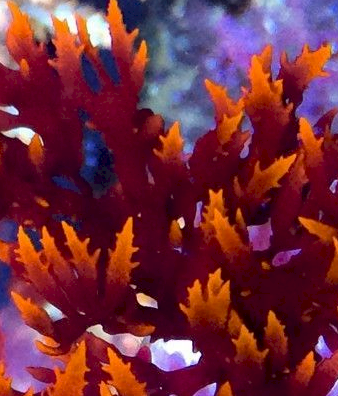
This species features attractive, flattened, flame shaped appendages with a coloration ranging from pink to dark red. Like all species of Halymenia, it’s very thin, gelatinous and smooth in texture and loses it’s form when removed from the water. It’s delicate and can break apart and tear easily when handled or subjected to high flow. It’s sometimes encountered as free floating specimens in seaweed mats, but it naturally grows attached to hard bottom in depths of up to 60ft or so. Single plants can grow very large and reach heights of almost 20″ or more. H. floresia requires a large amount of nutrients to keep successfully in the aquarium and moderate to high flow to maintain its slippery, fleshy blades. In the aquarium it will seldom attach to anything so specimens can be anchored or allowed to tumble free floating. It’s very palatable and is readily eaten by both tangs, angels and other herbivores.

Scientific Name: Halymenia floresia

Common Name: Red Sea Lettuce, Dragons Tongue

Origin: Gulf of Mexico, Caribbean, Tropical Atlantic

Depth Collected: 20-130 feet

Maximum Height: 20″

Growth Rate: Slow

Light: Moderate to Low

Temperature: 78-84

Propagation: Fragmentation, sporulation

Difficulty: Moderate

Food Value: Very palatable

Nutrient Uptake: Good

Flow Rate: Moderate to High