Chaetomorpha Sp.

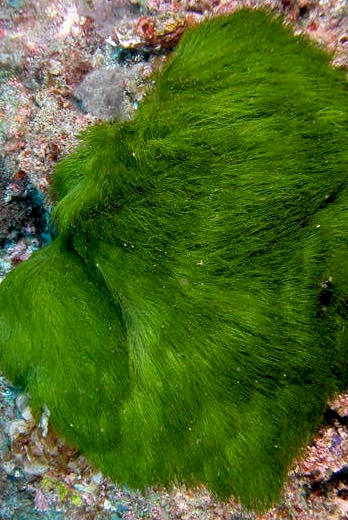
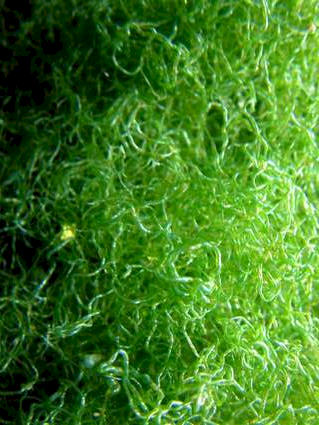
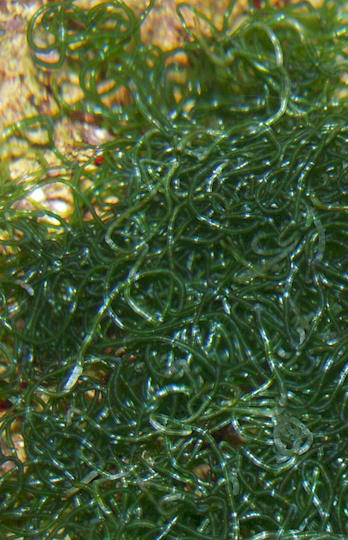
A unique variety of green algae that is native to nutrient rich areas such as bird islands, lagoons and protected shallow waters. It features a thick, tangled mass of filaments that resemble fishing line. Chaetomorpha is very hardy in the aquarium, as it grows in the inter-tidal zone often left completely exposed at low tide. A fast grower, its use is heavily commercialized today in the aquarium industry because of its ability to quickly remove excess nutrients from the aquarium. A favorite of “reef aquarium” hobbyists, as it does not release nutrients and harmful toxins back into the aquarium. There are several varieties available to the hobbyist today, some hardier than others but all are excellent at filtering aquarium water. Not palatable to fish or invertebrates. Typically it’s tumbled or allowed to simply rest on the sand bed in a refugium. It should be thinned out regularly as tissue underneath will start to deteriorate.
Scientific Name: Chaetomorpha Sp.

Common Name: Chaeto, Spaghetti Algae

Origin: Gulf of Mexico, Atlantic, Caribbean

Depth Collected: 1-10 Feet

Maximum Height : 24″ mound

Growth Rate: Fast

Light: Low to High

Temperature: 76-86

Propagation: Fragmentation, Sporulation

Difficulty: Easy

Food Value: Not Palatable

Nutrient Uptake: Excellent

Flow Rate: Moderate 
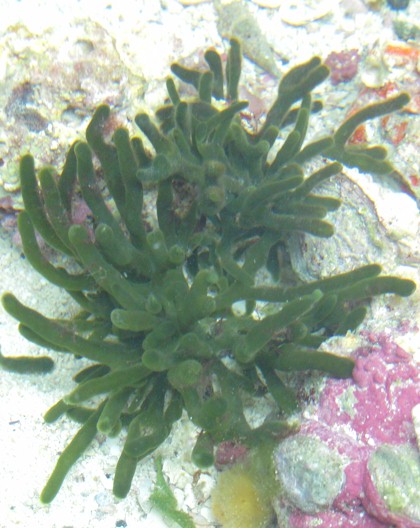
Codium Sp.

A temperate water species that’s found worldwide. This particular algae features dark green, cylindrical branches connected by a single holdfast to rocks, shell fragments and hard bottoms. The branching is irregular and features soft fuzzy filaments at the tips resembling the fingers of a sponge. Individual species of Codium are abundant in shallow water habitats up to 60ft deep. Most varieties prefer cooler water temperatures so are normally available to the hobbyist seasonally. Depending upon the species they can grow as large as 12″ tall. Not palatable to fish or invertebrates. Keeping aquarium water well below 80 degrees is important, as individual specimens will quickly fall apart if the water becomes too warm.

Scientific Name: Codium Sp.

Common Name: Dead Mans Fingers, Sponge Algae

Origin: Worldwide Distribution

Depth Collected: 1-30 Feet

Maximum Height : 12″

Growth Rate: Slow

Light: Moderate to High

Temperature: 65-80

Propagation: Fragmentation, Sporulation

Difficulty: Easy

Food Value: Not Palatable

Nutrient Uptake: Fair

Flow Rate: High

Cymopolia barbata

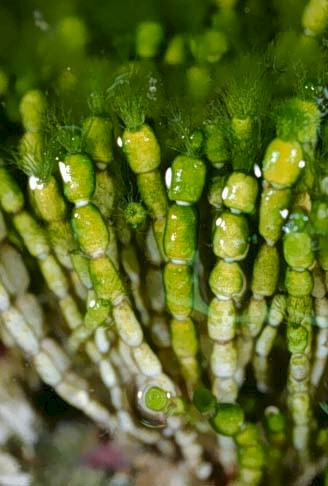
An interesting species of calcareous algae that is prized for it’s bright green appearance that almost glows underwater. It features heavily calcified, segmented uprights, with bright green fuzzy filaments at each tip. It’s a delicate species and will often secrete a green fluid when disturbed and loses it’s form when taken out of the water. It’s a shallow water specimen that often forms dense forests in the tidal zone attached to hard bottom, rocks and coral fragments. Calcium supplementation is needed, as with all species of calcareous macro algae. It holds up fairly well in the aquarium but will eventually lose most of the top growth in captivity unless it is provided with very intense lighting. It’s not known to be very palatable to fish or invertebrates.

Scientific Name: Cymopolia barbata

Common Name: Tufted Joint Weed

Origin: Bahamas, Eastern Caribbean, Atlantic

Depth Collected: 1-5 Feet

Maximum Height : 12″

Growth Rate: Slow

Light: High

Temperature: 76-86

Propagation: Fragmentation, Sporulation

Difficulty: Moderate

Food Value: Not very palatable

Nutrient Uptake: Fair

Flow Rate: High

Chlorodesmis sp.

Imported from the Pacific as an ornamental macroalgae. It’s often mistaken for a type of hair algae. It features fine filaments, resembling strands of hair or thread attached by a single holdfast. Not palatable to fish as it contains toxic compounds that are known to not only discourage fish but also effect coral growth. This algae requires very high current and strong lighting to successfully grow in the aquarium.

Scientific Name: Chlorodesmis sp.

Common Name: Turtle Weed, Maiden’s Hair

Origin: Australia, S. Pacific

Depth Collected: 10-50 Feet

Maximum Height : 8″

Growth Rate: Moderate

Light: High

Temperature: 72-80

Propagation: Fragmentation, Sporulation

Difficulty: Advanced

Food Value: Not Palatable

Nutrient Uptake: Good

Flow Rate: Moderate to High

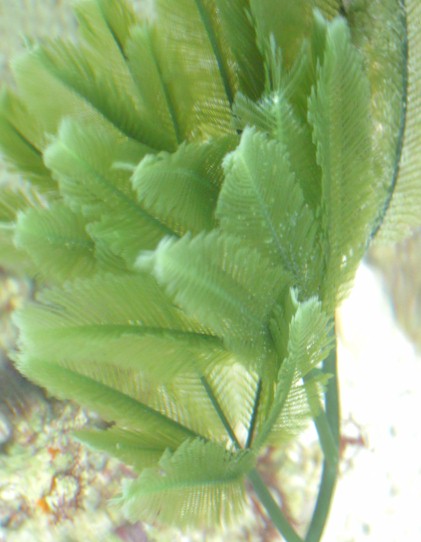
Caulerpa taxifolia

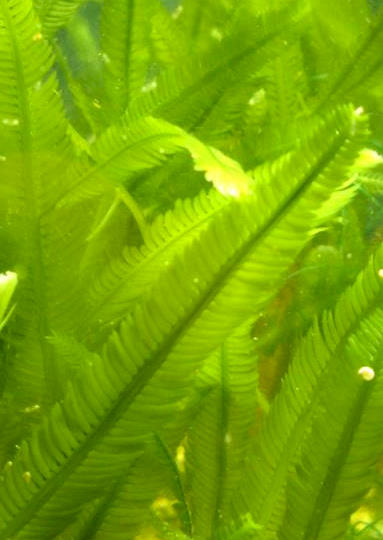
This species features long, dark green, fronds with segmented appendages. Its very similar to Caulerpa mexicana, but it’s fronds are spaced further apart and have a more uniform, tapered shape. It is also much more tolerant to a wide range of temperatures and a voracious grower in both the aquarium and in its natural environment. For this reason it is the single most controversial species of Caulerpa, as it can quickly take over non-native, nutrient rich waters if introduced. Today, it is rarely seen in the United States due to its recent addition to the Federal Noxious Weed List and infiltration of non-local waters. It is currently illegal to ship or transport this particular algae from any location and possession is banned in the state of California. Despite its reputation, there are many aquarium strains still in propagation in aquariums throughout North America, as well as Europe and Asia. It has been reported to grow occasionally in Florida waters, but has not been a problem due to the abundance of competing algae. Not palatable to fish or invertebrates.

Scientific Name: Caulerpa taxifolia

Common Name: Fern Algae

Origin: Mediterranean, Caribbean

Depth Collected: 4-40 Feet

Maximum Height : 10″

Growth Rate: Fast

Light: Moderate

Temperature: 60-84

Propagation: Fragmentation, Sporulation

Difficulty: Easy

Food Value: Not Palatable

Nutrient Uptake: Excellent

Flow Rate: Low to Moderate

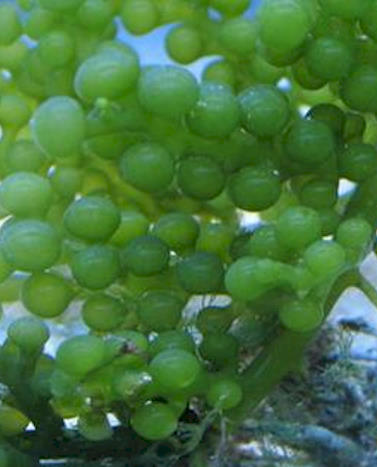
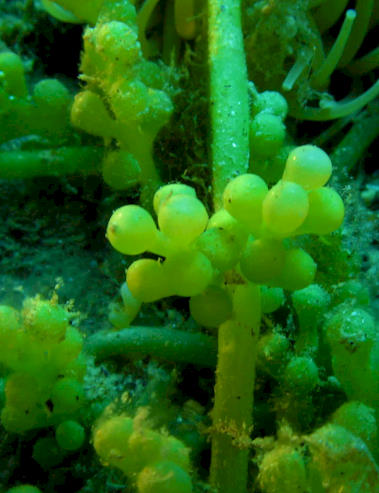
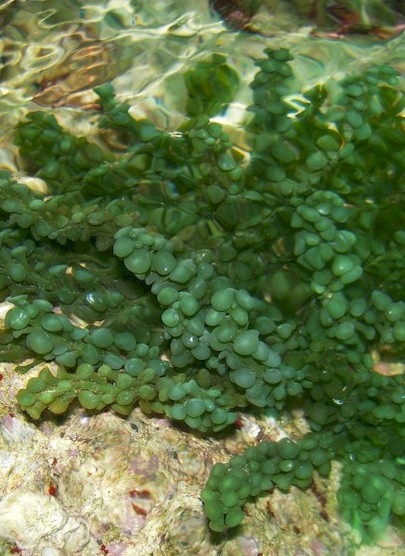
Caulerpa racemosa 

They’re many subspecies and variations of Caulerpa racemosa found worldwide. This species of racemosa is unique in that it has perfectly round individual clusters, resembling grapes on a vine. Like most species of racemosa, individual plants can quickly outgrow the available nutrients in a tank, so care must be taken to limit the size of each specimen. It grows in the inter-tidal zone in fairly shallow water and depends upon moderate to high currents to supply the essential nutrients required for growth. It should be closely monitored in the aquarium, as its well known for dying and releasing reproductive spores in captivity. Overall it’s a very hardy macroalgae that does very well in the marine aquarium.

Scientific Name: Caulerpa racemosa 

Common Name: Grape Caulerpa, Sea Grapes

Origin: Gulf of Mexico, Caribbean, Brazil

Depth Collected: 2-50 Feet

Maximum Height : 8″

Growth Rate: Fast

Light: Moderate to High

Temperature: 72-86

Propagation: Fragmentation, Sporulation

Difficulty: Easy

Food Value: Somewhat Palatable

Nutrient Uptake: Excellent

Flow Rate: Moderate to High
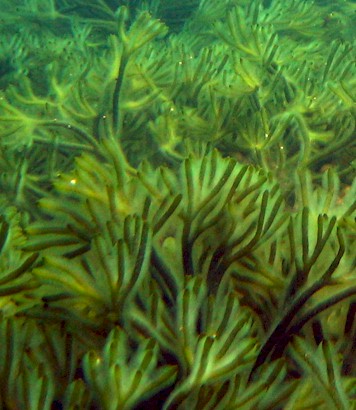
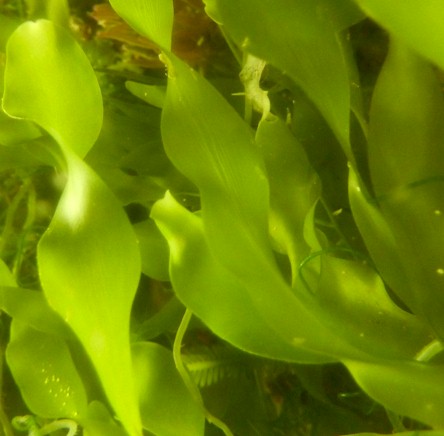
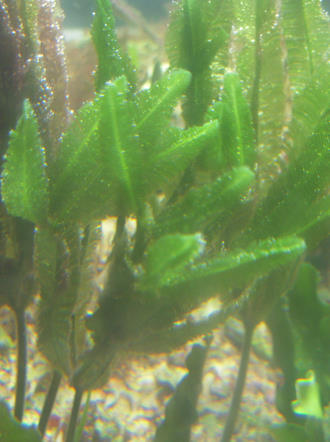
Caulerpa prolifera

By far the most popular and widely distributed species of Caulerpa available for use in the aquarium. This species features dark green, slender, oval shaped blades attached to a single rhizome. It often has new growth that appears on old blades which is true to its name. Depending on the environment provided, it can grow very wide blades (up to 1″) in turbulent areas and grows tall and thin in shallow, calm habitats. Individual blades are often spiral shaped when collected from shallow waters, especially when found in sea grass beds. Not very palatable to fish, but will be nipped at by some herbivores. It prefers to grow on sandy substrate, and once established, will quickly grow over the front of an aquarium.

Scientific Name: Caulerpa prolifera

Common Name:  Sea Blade Algae

Origin: Gulf of Mexico, Atlantic, Caribbean

Depth Collected: 4 – 30 Feet

Maximum Height : 6″

Growth Rate: Fast

Light: Moderate

Temperature: 76-86

Propagation: Fragmentation, sporulation

Difficulty: Easy

Food Value: Somewhat palatable

Nutrient Uptake: Excellent

Flow Rate: Low to Moderate

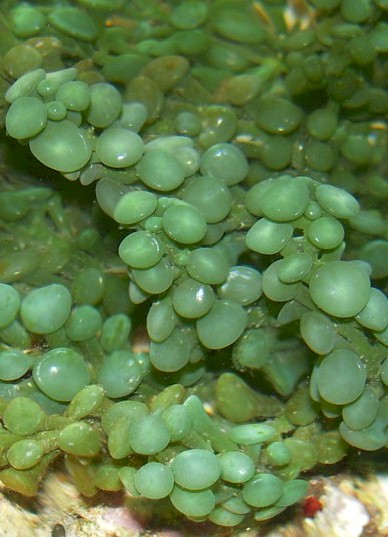
Caulerpa racemosa var. peltata

This species of Caulerpa features a thick rhizome, with compact clusters of rounded or flat topped uprights. This particular algae is usually found in low light habitats such as shaded seawalls, under ledges or in very deep water. In the aquarium it is an excellent nutrient consumer, so much so that it must be monitored so that it does not outgrow the available nutrients. It is highly variable in characteristics depending on where it is collected. There are two distinct varieties, although it is unsure if they’re separate species. One features smooth round caps, while the other has a more concave shape with thin edges. In shallow water, the uprights grow much taller, more closely resembling Caulerpa racemosa. Somewhat palatable to fish.

Scientific Name: Caulerpa var. peltata

Common Name: Saucer Algae, Mushroom Algae

Origin: Gulf of Mexico, Atlantic, Caribbean

Depth Collected: 3-200 Feet

Maximum Height : 6″

Growth Rate: Fast

Light: Moderate

Temperature: 72-86

Propagation: Fragmentation, Sporulation

Difficulty: Easy

Food Value: Somewhat Palatable

Nutrient Uptake: Excellent

Flow Rate: Moderate
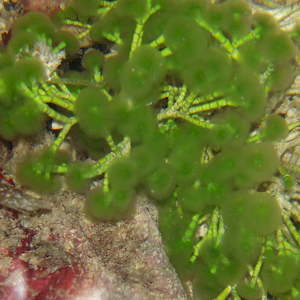
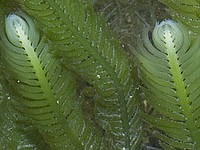
Caulerpa paspaloides

Caulerpa paspaloides features palm shaped fronds that extend upward in clusters to form a symmetrical tip. This species is fast growing and very hardy in the marine aquarium. Under intense lighting it forms tight, dark green filaments that have a triangular appearance. Under most aquarium conditions however, the growth is much different and resembles individual feather shaped fronds with a light green appearance. A thick rhizome securely anchors the plant in mud and shallow turbulent environments. Because of its fine filaments it can accumulate sediment and diatom growth so it should be pruned from time to time. Simply pinching the rhizome and breaking off individual pieces is recommended. It’s not as palatable to fish as other species of Caulerpa.

Scientific Name: Caulerpa paspaloides

Common Name: Palm Tree Algae

Origin: Gulf of Mexico, Atlantic, Caribbean

Depth Collected: 5 -10 Feet

Maximum Height : 12″

Growth Rate: Moderate

Light: Moderate

Temperature: 78-86

Propagation: Fragmentation, sporulation

Difficulty: Easy

Food Value: Somewhat palatable.

Nutrient Uptake: Excellent

Flow Rate: Low to Moderate

Caulerpa mexicana

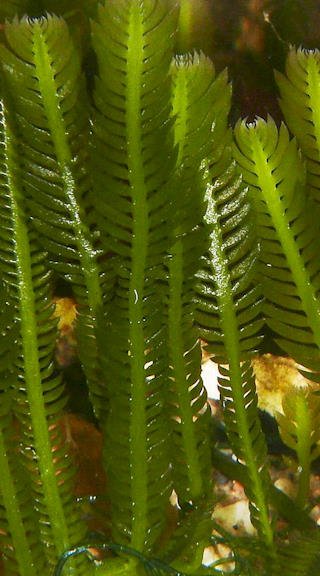
Caulerpa mexicana has a deep green color with beautiful segmented fronds. It grows rather compact in turbulent environments, but can extend into larger leaflets up to 6″ tall in calmer conditions. Attaches with rhizomes to rocks, coral fragments as well as sandy and mud bottoms in shallow protected areas. This species is very adaptable in the amount of light it requires to grow and is often observed growing under ledges on seawalls and intertwined with other algae. There are several species of Caulerpa that are very similar in shape such as taxifolia and scalpelliformis, but they lack the tight segmented fronds and somewhat rounded tips characteristic of this macro algae. An excellent, hardy specimen for the marine aquarium. Most Caulerpa species are very palatable to fish and invertebrates.

Scientific Name: Caulerpa mexicana

Common Name: Fern Algae

Origin: Gulf of Mexico, Atlantic

Maximum Height : 8″

Growth Rate: Moderate

Light: Moderate

Temperature: 78-84

Propagation: Fragmentation, sporulation

Difficulty: Easy

Food Value: Somewhat palatable to fish

Nutrient Uptake: Good

Flow Rate: Low to Moderate