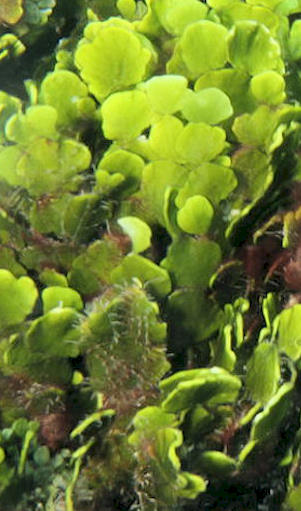
Neomeris annulata

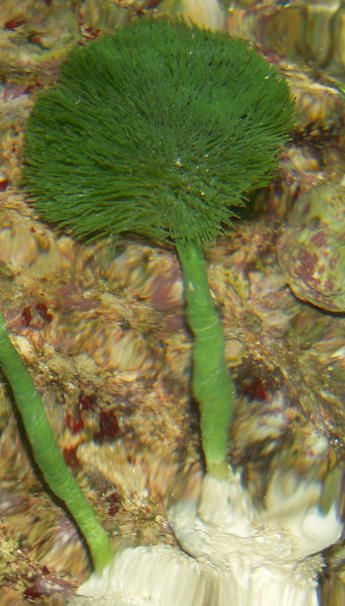
An attractive, lightly calcified species of green macro algae that grows as small clusters or single solitary specimens. It features dark green, finger-like uprights, that are spongy and fuzzy at the top. This particular algae makes its appearance in the hobby on collected live rock and individual specimens on small shells from both the Pacific and Atlantic Ocean. It grows in fairly shallow water and is somewhat delicate and prefers less current, often attaching to mangrove roots and coral fragments in protected waters. It does fairly well in the aquarium, but its growth rate is minimal so the efficiency of nutrient uptake is limited. Somewhat palatable, but usually left alone. Calcium supplementation is recommended to maintain this specimen in the aquarium.
Scientific Name: Neomeris annulata

Common Name:  Finger Algae

Origin: Gulf of Mexico, Atlantic, Caribbean

Depth Collected: 1 – 30 Feet

Maximum Height : 4″

Growth Rate: Slow

Light: Moderate

Temperature: 78-86

Propagation: Fragmentation, sporulation

Difficulty: Moderate

Food Value: Somewhat palatable

Nutrient Uptake: Fair

Flow Rate: Low
Udotea flabellum

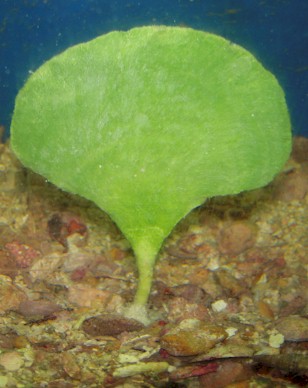
A calcareous algae that is very popular in the aquarium. It features a broad, dark green, fan shaped top that can grow as large as 12″ or more. A cluster of rhizoids holds the plant upright and securely in the substrate. The large base (rhizoids) can extend several inches below the substrate, where “shoots” form new plants from the parent colony. When conditions are favorable in the aquarium, this species will reproduce rapidly by producing new plants near the base. Like many of the calcareous algae that grow exclusively in substrate, it needs a deep sand bed of 4″ or more. Calcium supplementation is needed and will provide optimum growth of up to 1″ per day. Not palatable to fish or invertebrates.

Scientific Name: Udotea flabellum

Common Name: Mermaid’s Fan

Origin: Atlantic, Caribbean

Depth Collected: 3-60 Feet

Maximum Height : 12″

Growth Rate: Moderate

Light: Moderate to High

Temperature: 76-86

Propagation: Fragmentation, Sporulation

Difficulty: Easy

Food Value: Not Palatable

Nutrient Uptake: Fair

Flow Rate: Moderate

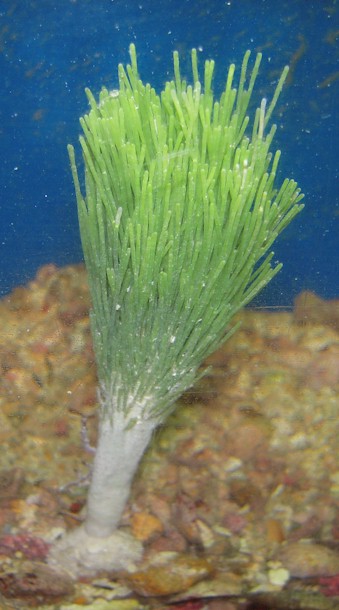
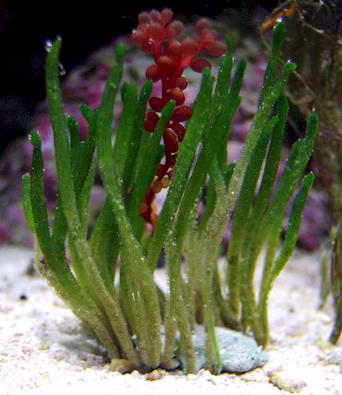
Penicillus capitatus

An attractive, calcareous algae that is abundant on the reef flat and among sea grass beds commonly referred to as a pencil cap. It features a thick stem with a rounded, fine filament top. Its root-like structure is a large bulb with a series of rhizoids that anchor it to substrate and sometimes rocks. Mature plants reach a height of about 8″ and 2″-3″ in diameter. It occurs in shallow calm protected water to depths of 30 ft. In the aquarium the mature plant often dies to produce new plants at the base. Like most calcareous stem plants, it needs a deep sand bed of 4″ or more to grow in the aquarium. Calcium supplementation is needed. Not palatable to fish or invertebrates.

Scientific Name: Penicillus capitatus

Common Name: Pencil Cap

Origin: Atlantic, Caribbean

Depth Collected: 1-30 Feet

Maximum Height : 8″

Growth Rate: Moderate

Light: Moderate to High

Temperature: 76-86

Propagation: Fragmentation, Sporulation

Difficulty: Easy

Food Value: Not Palatable

Nutrient Uptake: Fair

Flow Rate: Low to Moderate
Halimeda incrassata

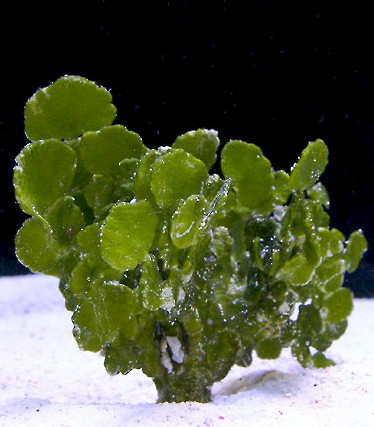
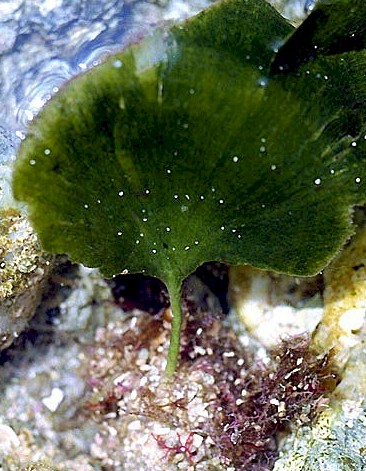
A heavily calcified algae that is abundant in shallow habitats to 40 feet deep. It features stiff, segmented fronds that are irregular and flat shaped. It grows in different forms, some forming large clumps and others with just 5-6 branches. Mature plants can grow as tall as 8″ or so, but most will stay small in an aquarium. A large cluster of rhizoids holds the plant upright and securely in the substrate. The large root like structure can extend several inches below the substrate, where “shoots” form new plants from the parent colony. When conditions are favorable in the aquarium, this species will reproduce rapidly by producing new plants near the base. Like many of the calcareous algae that grow exclusively in substrate, it needs a deep sand bed of 4″ or more. Calcium supplementation is also needed to keep successfully in the aquarium. Not palatable to fish or invertebrates.

Scientific Name: Halimeda incrassata

Common Name: Halimeda

Origin: Atlantic, Caribbean, Gulf of Mexico

Depth Collected: 3-40 Feet

Maximum Height : 8″

Growth Rate: Moderate

Light: Moderate to High

Temperature: 76-86

Propagation: Fragmentation, Sporulation

Difficulty: Easy

Food Value: Not Palatable

Nutrient Uptake: Fair

Flow Rate: Moderate

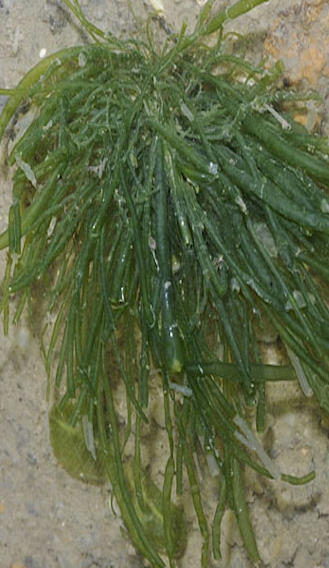
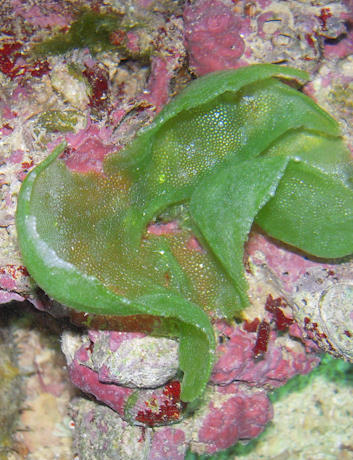
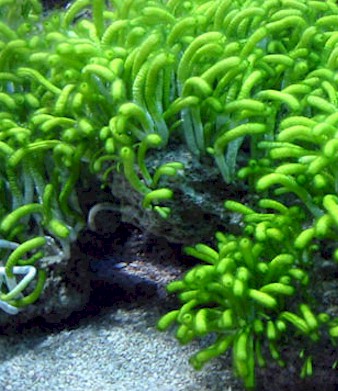
Enteromorpha Sp.

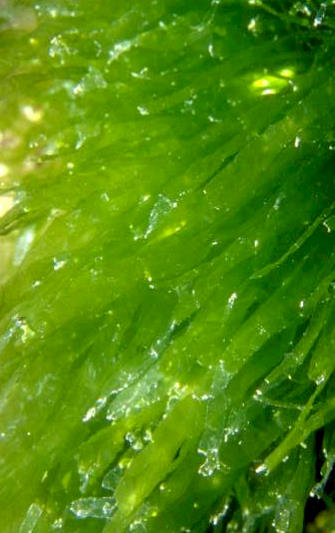
A distinctive green algae that is in the family Ulvales. It’s both a temperate and tropical species, abundant in different forms worldwide. This particular algae features long, slippery tubes or fingers rising from the center of the plant attached by a single holdfast. The Latin term “Enteromorpha” literally means intestine-shaped. It grows in large clumps at the low tide zone on mangrove roots and coarse substrate. It tolerates a wide range of salinities from 17 ppt. to 40 ppt. and is often found at the base of rivers and brackish water estuaries. Like other species of Ulva, it prefers cooler water temperatures in the aquarium and will not do well in temps over 80 degrees. Like other varieties, its very palatable to fish.

Scientific Name: Enteromorpha sp.

Common Name: Tube Algae

Origin: Worldwide Distribution

Depth Collected: 1-15 Feet

Maximum Height : 10″

Growth Rate: Fast

Light: Moderate to High

Temperature: 60-78

Propagation: Fragmentation, Sporulation

Difficulty: Easy

Food Value: Very Palatable

Nutrient Uptake: Excellent

Flow Rate: Low to Moderate 

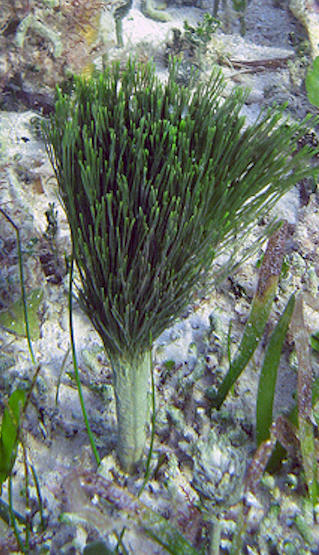
Penicillus dumetosus

This beautiful species of Penicillus is very similar in appearance to P. capitatus, but it’s more heavily calcified and features a short stem, with coarse bristle-like filaments. These particular plants grow much larger than other species of Penicillus, up to 8″ tall. A distinct characteristic of this calcareous algae is that the top is more tapered and flat like a shaving brush which is the common name for this algae. It’s abundant on the reef flat and among sea grass beds in sandy substrate.  It’s root-like structure is a large bulb with a series of rhizoids that anchor it to substrate and sometimes hardbottom. It occurs in shallow calm protected water to depths of 40 ft. In the aquarium the mature plant often dies to produce new plants at it’s base. Like most calcareous stem plants, it needs a deep sand bed of 4″ or more to grow in the aquarium. Calcium supplementation is needed. Not palatable to fish or invertebrates.

Scientific Name: Penicillus dumetosus

Common Name: Mermaid’s Shaving Brush

Origin: Atlantic, Caribbean

Depth Collected: 1-30 Feet

Maximum Height : 8″

Growth Rate: Moderate

Light: Moderate to High

Temperature: 76-86

Propagation: Fragmentation, Sporulation

Difficulty: Easy

Food Value: Not Palatable

Nutrient Uptake: Fair

Flow Rate: Low to Moderate
Halimeda discoidea

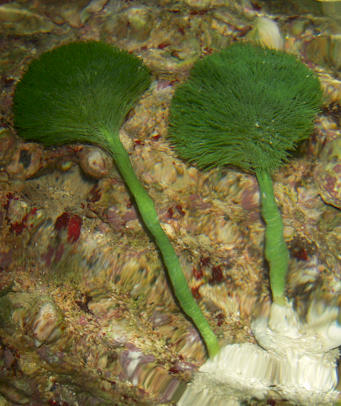
A heavily calcified algae that’s abundant in both shallow and deep water habitats to depths of 100 feet or more. It features large, calcified segments with irregular disc shaped formations. It has the largest individual segments of all Halimeda species. Discoidea has a single holdfast that typically attaches to rocks, shells and hard bottom. Unlike other species of Halimeda, it grows exclusively on hard surfaces and not in sand substrate. This particular species is most often associated with collected and aqua cultured live rock. Like all species of calcareous algae it needs regular calcium supplementation for growth in the aquarium. It does not grow as quickly in the aquarium as other varieties, but is very hardy and attractive.

Scientific Name: Halimeda discoidea

Common Name: Money Plant

Origin: Atlantic, Caribbean, Gulf of Mexico

Depth Collected: 3-100 Feet

Maximum Height : 10″

Growth Rate: Moderate

Light: Moderate to High

Temperature: 76-86

Propagation: Fragmentation, Sporulation

Difficulty: Easy

Food Value: Not Very Palatable

Nutrient Uptake: Fair

Flow Rate: Moderate

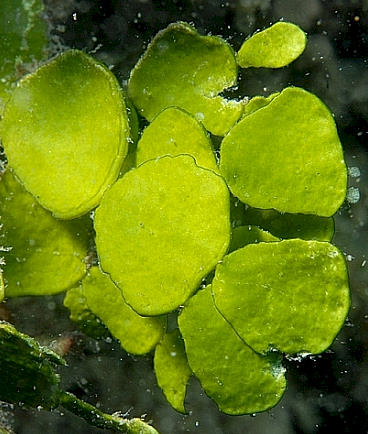
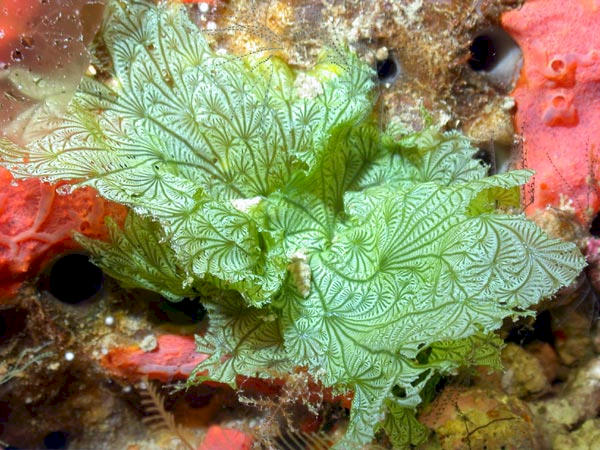
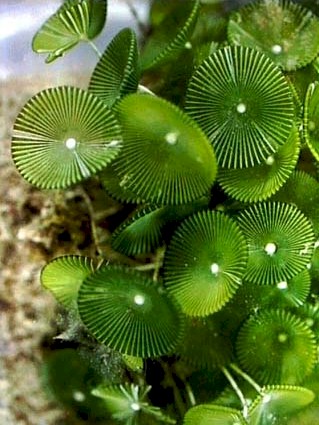
Anadyomene Sp.

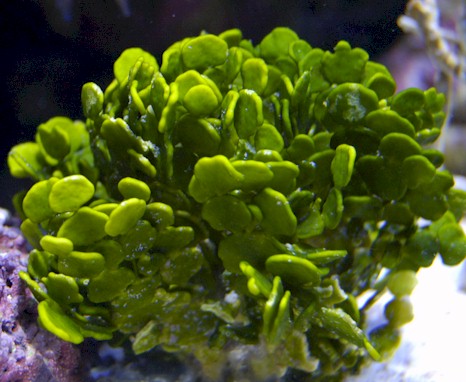
Anadyomene is a highly variable green macro algae that grows in depths of 2-100 feet. It features rounded, stiff, irregular shaped blades or lobes that have a distinct pattern of intricate veins when examined closely. There are several species that are occasionally seen in the aquarium industry, but most are attached to collected live rock or amongst harvested calcareous algae. The most commonly available specimens are anadyomene Saladanhae, Stellata, and Cavernosa . Some single specimens can grow in large clumps of up to 10″ in diameter, but in the aquarium growth is much smaller. A slow grower, but a fairly hardy specimen in the marine aquarium. 

Scientific Name: Anadyomene Sp.

Common Name: Sea Lettuce, Basket weave

Origin: Gulf of Mexico, Atlantic, Caribbean

Depth Collected: 2-100 Feet

Maximum Height : 10″

Growth Rate: Slow

Light: Moderate

Temperature: 78-86

Propagation: Fragmentation, sporulation

Difficulty: Moderate

Food Value: Palatable to some fish 

Nutrient Uptake: Poor

Flow Rate: Moderate 

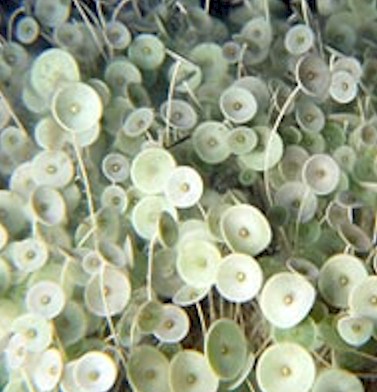
Acetabularia Sp.

Acetabularia is a unique and beautiful species of green algae. It features a lightly calcified stem that hosts a single disc like appendage. There are many species of this unique algae, some with more pronounced cup shaped tops and varying shades of green coloration. When removed from the water, care must be taken as the tops can not be supported by the thin stem and will often break off. New colonies can be started by a single disc, although the growth is very slow. Specimens grow in shallow, protected environments often attached to shells, mangrove roots and other hard surfaces. This species requires a brightly lit, protected area to grow successfully in the aquarium. It can be difficult to harvest as most specimens are attached to rocks, roots and other hard surfaces. The easiest method for collection is to find it growing on a shell or another species of algae. Unfortunately, the lifespan of this species is very short lived and rarely survive very long in captivity.

Scientific Name: Acetabularia Sp.

Common Name: Mermaids Wine Glass

Origin: Gulf of Mexico, Atlantic, Caribbean

Depth Collected: 1-10 Feet

Maximum Height : 4″

Growth Rate: Slow

Light: Minimal

Temperature: 78-86

Propagation: Fragmentation, Sporulation

Food Value: Not Very Palatable

Nutrient Uptake: Poor

Flow Rate: Low